Clean data, before you migrate.
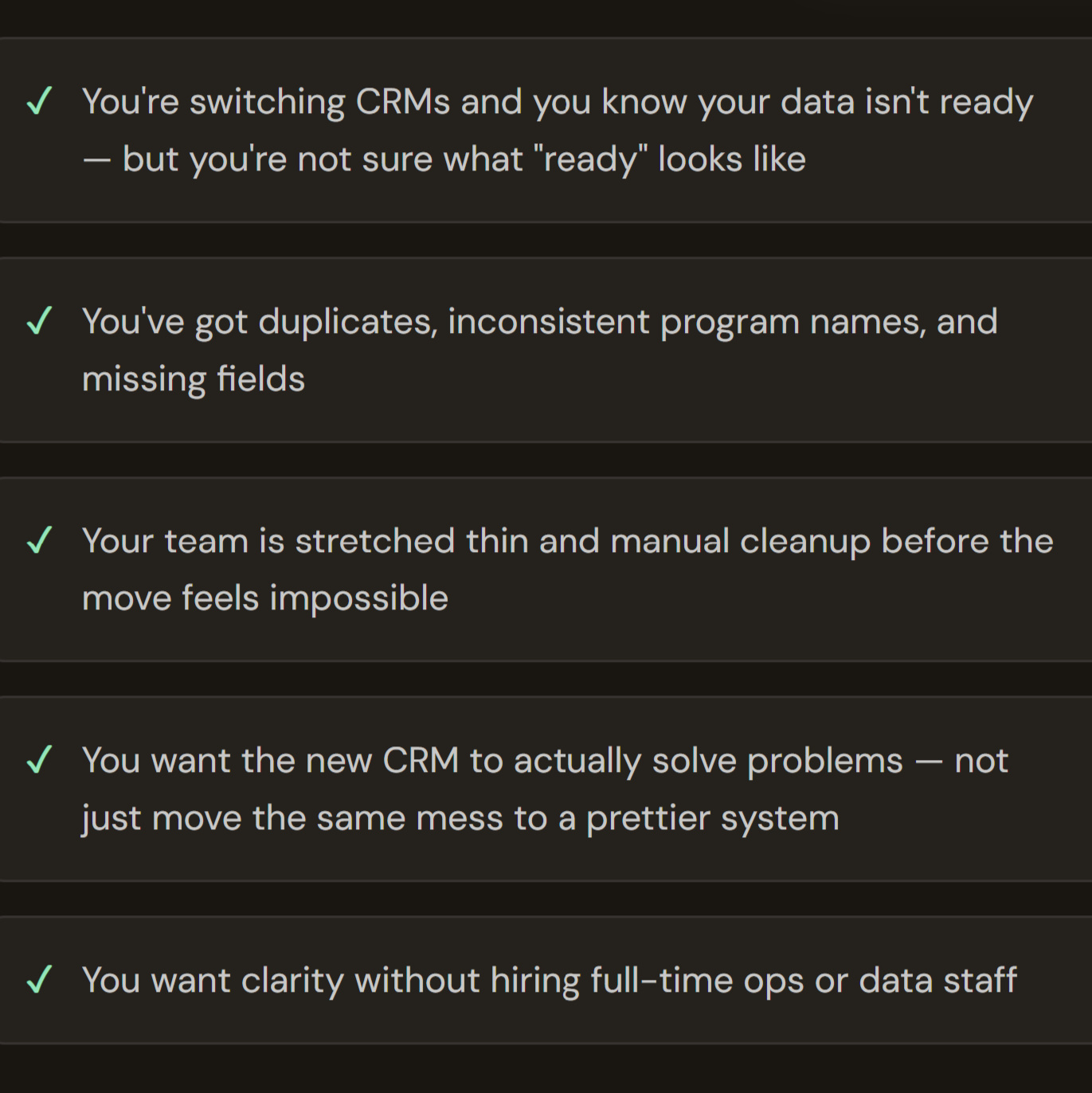
I help nonprofits clean and organize their spreadsheet or CRM data before migrations, audits, and reporting projects — so your team spends less time fixing records and more time focusing on impact.

.
How data cleanup helped
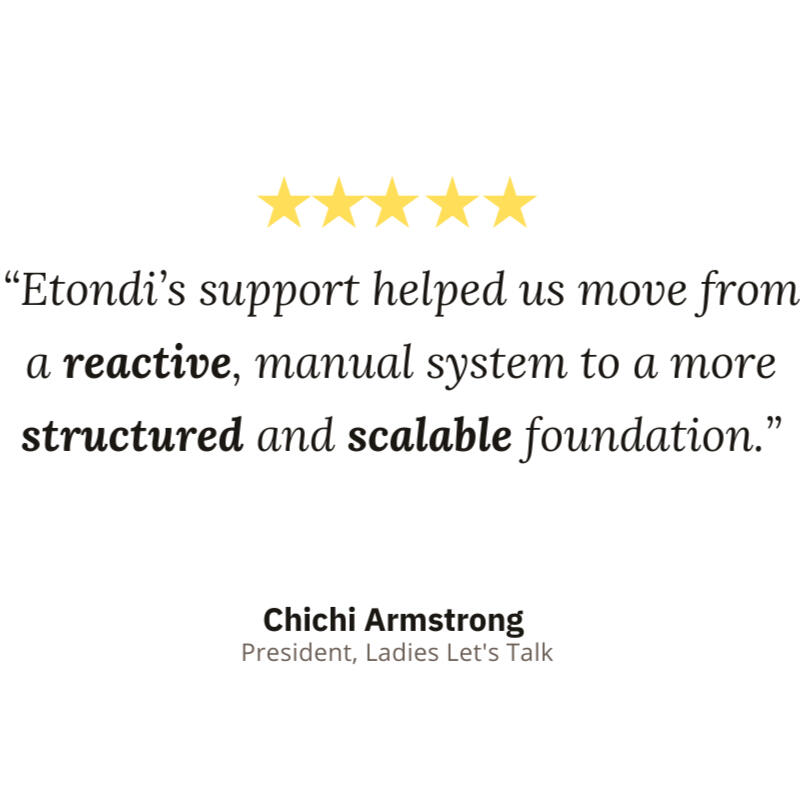
Ladies Let's Talk build a stronger foundation
Get clear on your data — or get it cleaned up.
Whether you need a starting point or hands-on cleanup support, the process is structured, async, and designed to keep things simple for your team.

Hi, I'm Etondi!
With 10+ years in customer service, I bring something a little different to data work: I understand people, not just systems.You’re not just getting technical cleanup. You’re getting someone who can translate between people, processes, and systems — so everything actually makes sense when it goes live.

I’m a nonprofit data consultant, but I’m also a wife, mom, and someone who lives somewhere between spreadsheets and anime marathons.I have ADHD, which honestly shows up as both a superpower and a “why are there 47 tabs open” situation — but it also makes me really good at spotting patterns, fixing chaos, and simplifying messy systems.Outside of work, I love gaming, anime, and anything that lets me disconnect and reset. And if life had a long-term wishlist attached to it, I’d eventually love to build an animal sanctuary — a calm, safe space for animals to just exist without stress.What I do professionally ties into who I am personally: I help nonprofits get their data in order before CRM migrations so things feel less chaotic and more intentional on the other side.
Here's exactly what
clean data looks like.
No fluff. No filler. A structured process to get your data cleaned, standardized, and ready — so whatever comes next doesn't start from a mess.
Every project is scoped individually.
These examples show common levels of complexity so you can get a sense of the investment range.
Final pricing depends on system complexity, data condition, and consolidation requirements.
Questions about the cleanup work
I scope it — you don't pick. After a data audit, I know exactly what systems are involved, how complex the cleanup is, and how much work it will take. The tier in your engagement offer is based on that, not a menu you choose from.
As a general guide: one to three spreadsheets with no CRM tends to be Tier 1. One CRM plus spreadsheets is usually Tier 2. Multiple CRMs or a long history of accumulated mess is Tier 3. But the audit always has the final say.
It's structured in phases, and everything happens within your client portal.
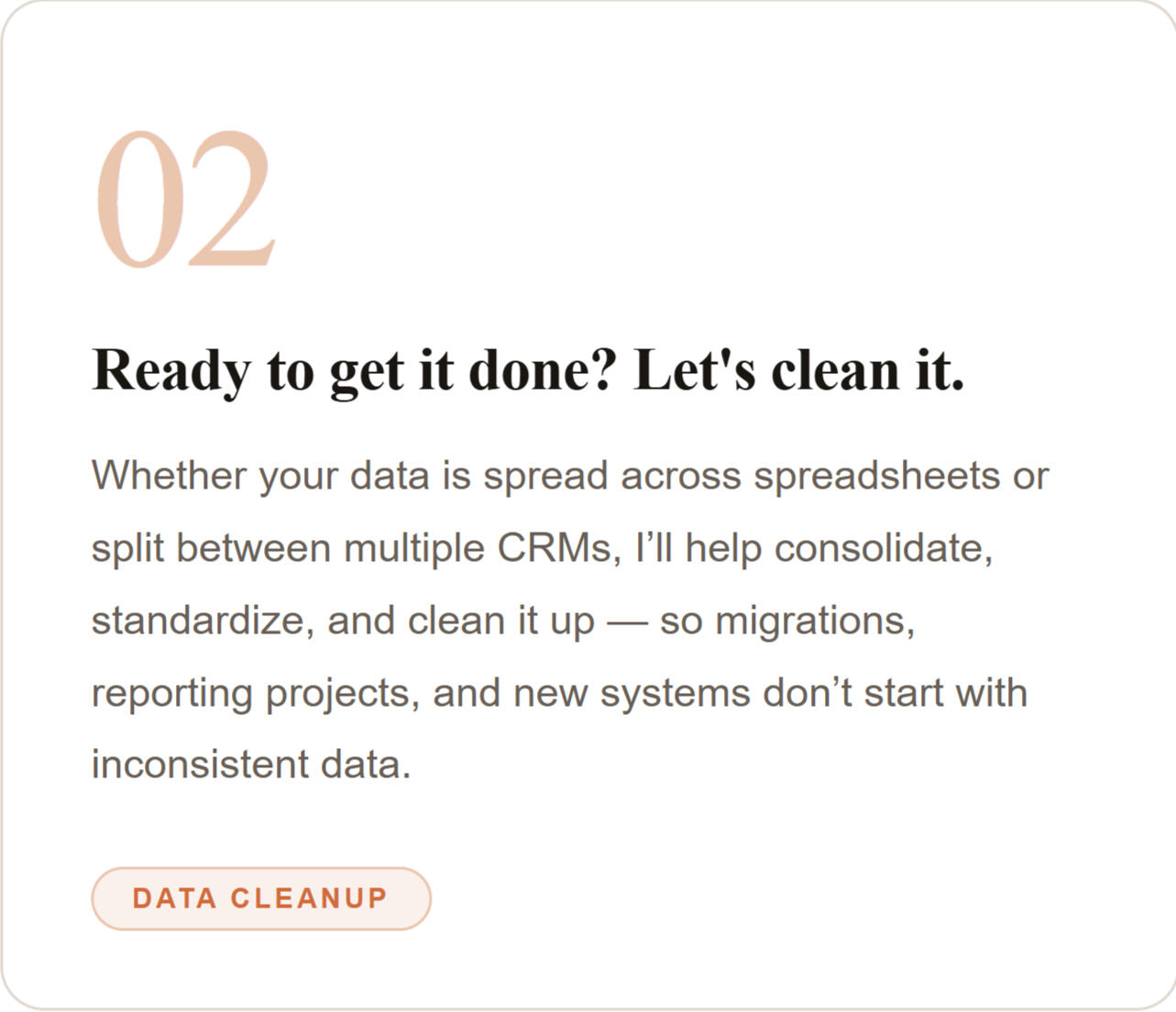
- I start with deduplication and standardization — names, phones, emails, dates, all the inconsistencies
- Then field alignment and structure — making sure everything maps correctly for wherever the data is going
- For multi-source projects, I consolidate records across systems and establish a single source of truth
- At the end, I run final validation checks and prepare import-ready datasets
You'll get written updates as the work progresses, and nothing changes in your systems without your sign-off first.
Clean and import-ready datasets. Along with that:
- A full change log of what was done and why
- A data standards guide so your team knows how to keep it clean going forward
- Documentation of any decisions made during the process (which records were merged, what was removed, why)
You won't just get cleaned data — you'll have a record of the work that makes it auditable and trustworthy.
It depends on what the initial audit finds. Complexity, number of systems, and record volume all factor in.
Your audit report will include a specific timeline estimate so you know exactly what to expect before committing to anything. There are no vague "4–6 weeks" placeholders — the scope is specific to your situation.
For the cleanup work itself, yes — I'll need working access to make changes. We agree on exactly what that looks like before anything starts, and I only touch what we've explicitly scoped together.
If full system access isn't possible, we can work through exports and imports instead. Either way, you'll have visibility into every change before it's finalized.
Hello, DataFlow focuses entirely on getting your data clean — not on what happens to it after. That means the following are out of scope:
- CRM selection consulting or vendor comparison
- Full system configuration or implementation
- Executing the migration itself
- Ongoing data entry support after handoff
Think of the work here as everything that happens before your implementation team steps in. When your data arrives clean and structured, that next phase goes a lot more smoothly.
Before you migrate, make sure your data is actually ready
Get clarity on what needs to be cleaned, fixed, and structured so your migration doesn’t carry over the mess.
No prep needed — just bring your current setup.
Google Sheets → Airtable
Ladies Let's Talk
LLT was moving from Google Sheets to Airtable, but their participant data had duplicates, inconsistencies, and cross-system mismatches. We cleaned everything up before the migration — so Airtable launched with solid data instead of inheriting a mess.
- Repeat form submissions created duplicate participant records — inflating headcount and making reports unreliable.
- Contact info didn't always match between Google Sheets and SimpleTexting — so nobody knew which system to trust.
- Leadership needed to know the data was solid before committing to the migration.
- All duplicates identified and flagged for review — before they ever touched Airtable.
- Cross-system checks confirmed which records matched, which were missing, and which needed updates.
- Leadership got a clear, actionable summary so they could make confident decisions before the move.
- Cleaned and standardized names, phone numbers, and emails so comparisons would actually work.
- Flagged duplicate records across learners and volunteers — about 100 duplicates out of ~1,266 total participants.
- Compared Google Sheets data against SimpleTexting to identify mismatches, missing records, and unsubscribed contacts.
- Built a summary for leadership showing exactly what needed to be added, updated, or resolved before migration.
Could your data use a reset like this?
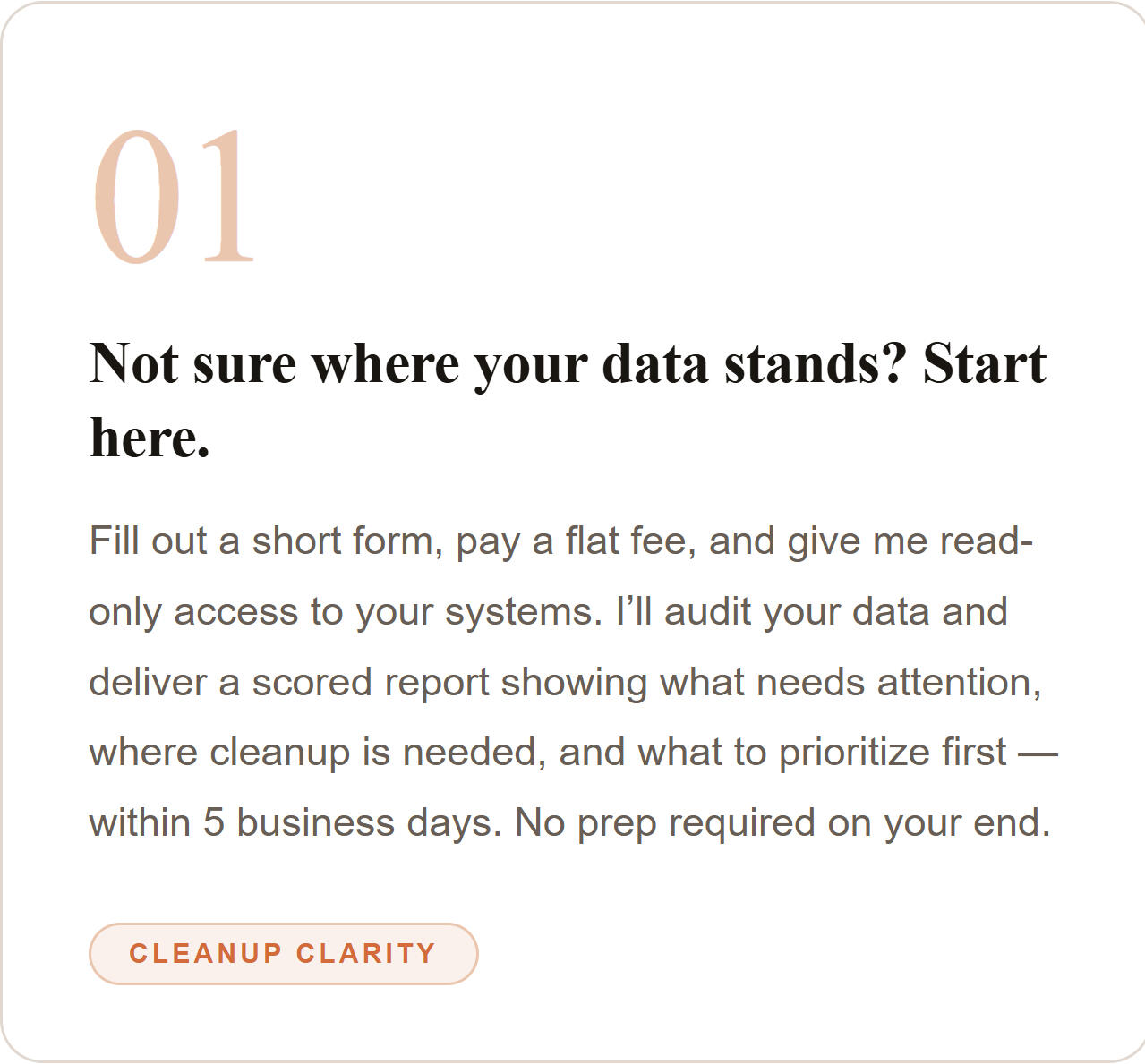
Start with a Cleanup Clarity audit and get a clear breakdown of what needs attention and where to start.
Get Cleanup Clarity →.
Find out exactly what's
wrong with your data
before you do anything else.
Book a time, tell me about your systems, and we'll start with a kickoff call to make sure the audit covers exactly what you need. A few days later, you have a scored report, a clear breakdown of what's broken, and a prioritized roadmap — specific to your data, not a generic checklist.
A real audit.
Not a template.
You get a structured report built specifically around your data — what I found, how serious it is, and where to start.
Simple on your end.
Thorough on mine.
You don't need to prep anything or clean anything up before we start. That's literally my job.
If you hire me for the cleanup, the full $750 is credited toward your project — as long as you move forward within 30 days.
what you're actually working with?
Book your slot and I'll see you on the kickoff call.
Questions you might be wondering
It starts with a booking — you pick a time, enter a few details about your org and the systems you want included, and pay the flat $750 fee. Then we have a short kickoff call so I can understand your situation and what you need from the audit. After that:
- You share read-only access to your data (or secure exports if that's easier)
- I do the full audit
- Your report lands in your inbox within 5 business days of the kickoff call
The report includes a clean score, area-by-area findings, an honest estimate of what it would take to fix, and a prioritized roadmap — specific to your systems, not a generic template.
More than just CRM data. If your nonprofit is dealing with messy records of any kind, there's a good chance I can help. That includes:
- Donor and constituent records
- Volunteer and program participant data
- Grant reporting and compliance data
- Spreadsheets that have grown into something unmanageable
- Data scattered across multiple systems that needs to be consolidated
The common thread is always the same: data that needs to be clean, consistent, and trustworthy — whether you're preparing for a migration, pulling a funder report, or just trying to actually use what you have.
Usually, yes — read-only access is the easiest way for me to get a full picture of what's there. If that's not possible, secure exports (CSV reports, shared views, screenshots) work too.
Nothing is ever changed or edited without your explicit sign-off. During the audit phase, I'm only looking.
Not at all. The roadmap in your report is yours to use however you'd like — hand it to a staff member, a volunteer, or another consultant. It's written to be actionable regardless of who does the work.
That said, if you do want to hire me within 30 days, the full $750 is credited toward your cleanup project. You won't pay for it twice.
There are no recurring meetings. Everything happens over email, with regular written updates as work progresses.
You'll always know what I'm working on, what I've found, and what's next — without anything taking over your calendar. I work at a calm, structured pace, and you can reach out with questions anytime.
Nonprofits, mostly — orgs that have been collecting data for a while and have ended up with records that are messy, inconsistent, or spread across too many places.
You don't have to be planning a migration to need clean data. If you're pulling grant reports manually, second-guessing your contact counts, or dreading what's in that spreadsheet — that's usually a sign it's time to sort it out.
No — Hello, DataFlow focuses entirely on getting your data clean and ready, not on executing migrations or configuring systems.
Think of it as the work that happens before your implementation team steps in. When your data arrives clean, standardized, and properly structured, the migration (or whatever comes next) goes a lot smoother.
Cleanup Clarity is delivered within 5 business days of receiving access to your systems.
For cleanup implementation, timelines are scoped based on what the audit finds — so you'll know exactly what to expect before committing to anything. Complexity, number of systems, and record volume all factor in.